


Call Us For Admissions 

+91 - 7818864419 +91 - 7818039239

OPD Calls / Patient Queries

+91 - 9286982270

Mail us for any query

sbbdcadmission@gmail.com

Our Blog

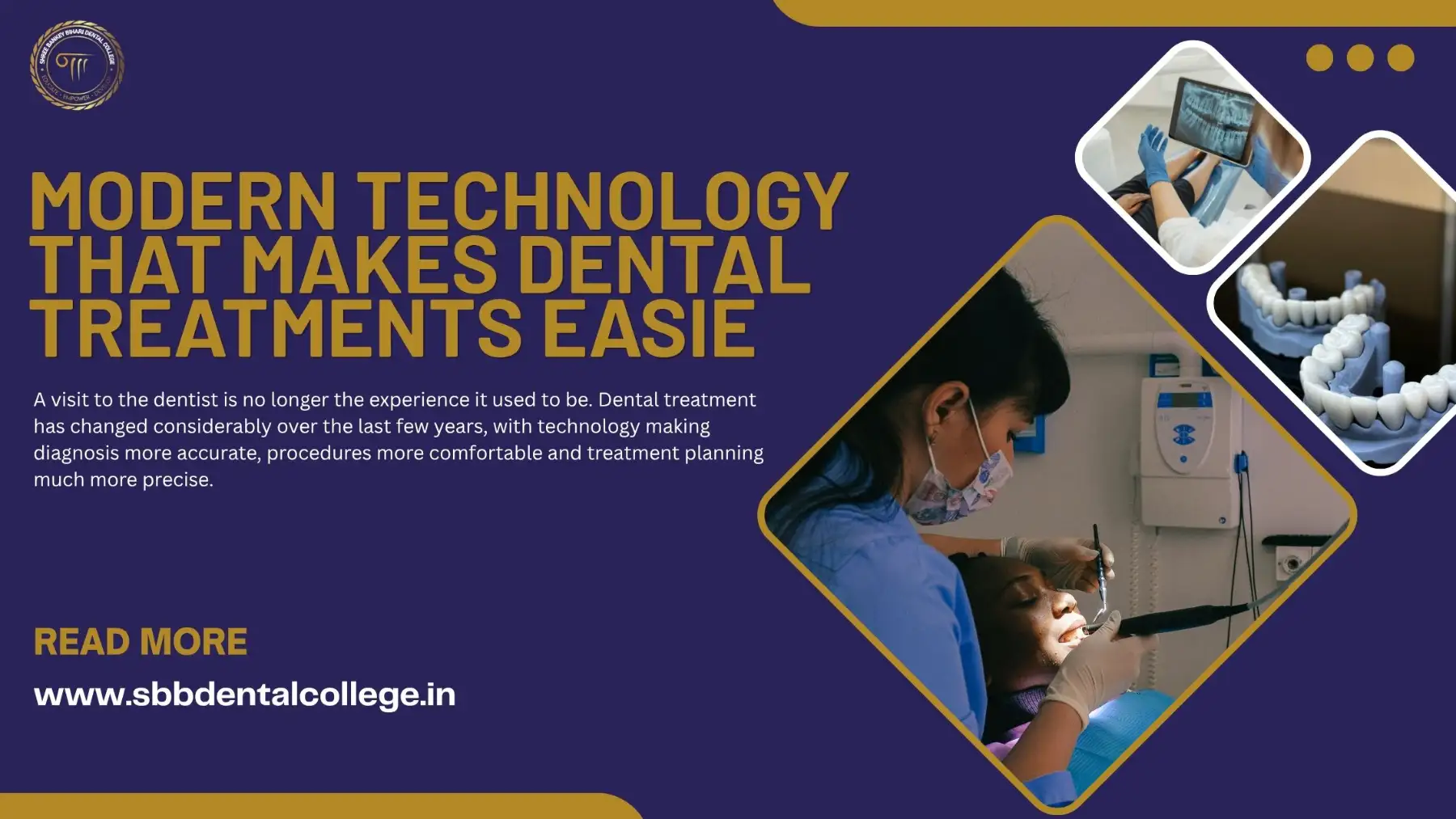
Modern Technology That Makes Dental Treatments Easier

A visit to the dentist is no longer the experience it used to be. Dental treatment has changed considerably over the last few years, with technology making diagnosis more accurate, procedures more comfortable and treatment planning much more precise.

From digital X-rays and advanced imaging to modern dental chairs and improved sterilesation systems, technology has become an important part of contemporary dental care. It not only helps dentists understand a patient's oral health better but also allows them to explain treatment options more clearly.

At Shree Bankey Bihari Dental College, modern dental education and clinical training go hand in hand. Students get an opportunity to understand how technology is used in different areas of dentistry while patients benefit from a clinical environment designed around modern dental practices.

For students looking for a dental institution, this combination of academics, clinical exposure and technology is worth considering while comparing the Top Dental College in Delhi, Best Dental Colleges in Delhi NCR, or colleges in the wider Meerut-Ghaziabad region.

Why Does Technology Matter in Modern Dentistry?

Dentistry is not simply about treating a tooth when it starts hurting. Modern dental care focuses increasingly on early diagnosis, prevention, accurate treatment planning and preserving natural teeth wherever possible.

Technology helps dentists achieve these objectives in several ways.

For example, digital imaging can provide a clearer view of teeth and surrounding structures. Computer-assisted treatment planning can help dentists study a case before beginning a procedure. Modern instruments can make certain procedures faster and more precise, while digital records make it easier to maintain and access a patient's treatment history.

For dental students, exposure to these technologies is equally important. Dentistry is a practical profession, and students need to understand not only the theory behind a procedure but also how modern equipment is used in actual clinical situations.

1. Digital Dental X-Rays for Faster Diagnosis

One of the most common technologies used in modern dental clinics is digital radiography.

Traditional dental X-rays required photographic film and chemical processing. Digital systems allow images to be captured electronically and viewed on a computer screen.

This offers several practical advantages. The image can be viewed quickly, enlarged when necessary and stored digitally. Dentists can also use the image to explain a problem to the patient, making conversations about treatment easier.

Digital radiography can be particularly useful for identifying problems that cannot be seen simply by looking inside the mouth, such as cavities between teeth, changes around the roots or certain bone-related concerns.

For students, learning to interpret dental radiographs is an important part of clinical education. It helps them connect what they learn in classrooms with what they observe during patient examination.

2. Advanced Dental Imaging Improves Treatment Planning

Sometimes a conventional X-ray is not enough to understand a complicated dental case. This is where advanced imaging technologies can play an important role.

Three-dimensional imaging systems such as Cone Beam Computed Tomography (CBCT) can provide detailed views of the teeth, jawbone and surrounding anatomical structures.

Depending on the clinical requirement, such imaging can assist dentists in planning procedures involving implants, impacted teeth, oral surgery and other complex cases.

The biggest advantage is that a three-dimensional view can provide information that may not be available from a conventional two-dimensional image.

For a dental student, exposure to such technology also builds an understanding of how diagnosis and treatment planning are evolving.

3. Intraoral Cameras Give Dentists a Better View

An intraoral camera is a small camera that can capture detailed images from inside the mouth.

It may seem like a simple technology, but it can make communication between dentist and patient much easier.

Instead of simply telling a patient that there is a cavity or another dental concern, the dentist can show the patient an image of the affected area on a screen.

This makes the discussion more visual and understandable.

Intraoral images can also become part of the patient's digital records and may be useful for monitoring changes over time.

For students, this technology encourages them to look at oral conditions carefully and understand how documentation forms an important part of modern dental practice.

4. Digital Records Make Patient Management Easier

Technology has changed not just the treatment room but also the way dental information is managed.

Digital patient records can contain details such as medical history, dental history, diagnostic images, treatment plans and previous procedures. Having this information organised electronically can make it easier for dental professionals to review a patient's history.

It can also help students understand the importance of maintaining proper clinical records.

Good dentistry requires more than technical skills. A professional dentist must also be able to document findings accurately, communicate with patients and maintain continuity of care.

5. Modern Dental Chairs Improve Patient Comfort

The dental chair may not seem like advanced technology, but modern dental units have evolved significantly.

Contemporary dental chairs are designed to allow dentists to position patients appropriately during different procedures. Integrated lighting, instrument systems, suction arrangements and other features can help create a more efficient working environment.

Patient comfort is also an important consideration.

A patient who is relaxed and properly positioned makes it easier for the dentist to carry out treatment. For students learning clinical procedures, an ergonomically designed dental setup can also make practical training more effective.

6. Dental Lasers Are Changing Certain Procedures

Dental lasers have become increasingly popular in selected areas of dentistry.

Depending on the type of laser and the procedure, they may be used in soft-tissue treatments, periodontal procedures and certain other dental applications.

Laser dentistry can offer advantages in appropriately selected cases, including precise tissue management and potentially reduced discomfort during some procedures.

However, technology does not automatically mean that every treatment should be performed using a laser. The dentist has to determine whether it is appropriate for a particular patient and procedure.

This is an important lesson for dental students as well: technology should support clinical judgement rather than replace it.

7. CAD/CAM Technology in Restorative Dentistry

Computer-Aided Design and Computer-Aided Manufacturing, commonly called CAD/CAM, have brought digital technology into restorative and prosthetic dentistry.

These systems can help dental professionals design restorations digitally and, depending on the setup, manufacture them with computer-controlled equipment.

Digital workflows can improve precision and reduce some of the manual steps involved in conventional processes.

For students interested in restorative dentistry and prosthodontics, understanding digital workflows is becoming increasingly valuable as the profession moves towards more technology-assisted treatment planning and fabrication.

8. Digital Dentistry Makes Communication Easier

One of the less-discussed benefits of technology is improved communication.

A dental problem can sometimes be difficult for a patient to understand when it is explained only verbally. Digital photographs, X-rays, scans and other visual tools can help dentists demonstrate what is happening.

For example, a dentist can show the difference between a healthy tooth and one requiring treatment. A patient can also better understand why a particular procedure has been recommended.

This can help patients participate more actively in decisions regarding their oral health.

Communication skills are especially important for dental students because they eventually have to interact with people of different ages, backgrounds and levels of dental awareness.

9. Improved Sterilisation and Infection Control

Technology in dentistry is not limited to diagnosis and treatment.

Infection control is one of the most important aspects of any dental clinical environment.

Modern sterilisation equipment and protocols help dental professionals clean, disinfect and sterilise instruments appropriately. Proper infection-control practices protect patients, dentists, dental assistants and students.

For a dental college, this is particularly important because a large number of students and patients may use clinical facilities every day.

Students therefore need to learn infection control as an integral part of professional dentistry rather than treating it as an additional requirement.

10. Technology Is Helping Dental Education Evolve

Technology has also changed the way dentistry is taught.

Dental students today have access to digital resources, presentations, videos, imaging systems and technology-assisted demonstrations that can supplement conventional classroom teaching.

However, technology alone cannot make someone a good dentist.

A student still needs strong fundamentals in anatomy, physiology, pathology, pharmacology and dental sciences. More importantly, students need hands-on clinical experience under appropriate supervision.

This is why students comparing the Best dental college in India should look beyond advertisements and rankings. They should consider the quality of teaching, clinical exposure, faculty, infrastructure, patient flow, practical training and the opportunity to work with modern dental equipment.

Clinical Exposure: Where Technology Meets Real Dentistry

The real value of dental technology becomes clear when students see how it is applied to actual patients.

At Shree Bankey Bihari Dental College, students can develop their understanding of dentistry through academic learning as well as clinical training.

Clinical exposure allows students to understand that every patient is different. The same dental problem may require different approaches depending on age, medical history, oral condition, expectations and other factors.

Technology can provide better diagnostic information, but the dentist still has to interpret that information and decide what is clinically appropriate.

This combination of knowledge + technology + hands-on training is what helps prepare students for professional practice.

Why Technology Should Be Considered While Choosing a Dental College

When students and parents begin researching colleges, they often focus on fees, location and infrastructure. These are certainly important, but they are not the only things that matter.

Technology and clinical facilities should also be considered.

A prospective student can ask questions such as:

  • • What kind of diagnostic equipment is available?
  • • Does the college provide sufficient clinical exposure?
  • • Are students trained to use modern dental technologies?
  • • How much practical work is included in the curriculum?
  • • Do students get opportunities to observe and assist in different dental procedures?
  • • Are infection-control and sterilisation protocols properly followed?
  • • Is the faculty experienced in both teaching and clinical practice?

These questions can provide a much clearer picture of a dental college than a ranking alone.

Shree Bankey Bihari Dental College: Combining Learning With Modern Dentistry

For students planning their dental education, Shree Bankey Bihari Dental College offers an environment where academic learning can be connected with clinical practice.

The college provides dental education across undergraduate and postgraduate levels, with students getting exposure to different areas of dentistry.

Its location also makes it a relevant option for students exploring dental education in the Delhi-NCR and western Uttar Pradesh region.

Students searching online for a Top Dental College in Delhi or Best Dental Colleges in Delhi NCR often look beyond Delhi itself because accessibility, clinical facilities and the overall learning environment are equally important.

Similarly, students searching for a Top Dental College in Meerut may also explore established dental institutions in nearby regions before making a final decision. Location is certainly useful, but it should be considered alongside academics and clinical training.

Technology Does Not Replace the Dentist

It is easy to assume that more technology automatically means better treatment. In reality, technology is a tool.

A sophisticated scanner cannot replace a dentist's clinical judgement. A digital X-ray cannot independently decide the right treatment. A laser cannot determine whether a procedure is actually necessary.

The dentist remains at the centre of the treatment process.

Technology simply gives the dental professional better information, greater precision and additional options in appropriately selected cases.

This is an important perspective for dental students to develop from the beginning of their education.

What Should Students Look for During Dental College Admission 2026?

Students preparing for Dental college admission 2026 should take time to compare institutions carefully instead of selecting a college only because it appears on a popular list.

A campus visit can be particularly useful.

During the visit, students can observe the dental departments, laboratories, lecture halls, clinical areas and patient facilities. They can also ask about clinical exposure, faculty, postgraduate departments, equipment and student activities.

Talking to current students can provide another useful perspective. They can often explain how much practical exposure students actually receive and how clinical training is organised.

The objective should not simply be to find a college with impressive-looking infrastructure. The goal is to find a place where students can develop the knowledge, skills and confidence required to become competent dental professionals.

The Future of Dentistry Is Becoming More Digital

Dental technology will continue to evolve.

Artificial intelligence, digital scanning, three-dimensional printing, computer-assisted planning and other innovations are gradually becoming part of modern dentistry. Some technologies that appear advanced today may become routine in dental clinics in the future.

This makes technological awareness increasingly important for today's dental students.

At the same time, the fundamentals of dentistry will remain just as important. Understanding patients, taking a proper history, conducting a thorough examination, making a sound diagnosis and communicating effectively will always be essential.

The dentist of the future will therefore need both clinical knowledge and technological awareness.

Final Thoughts

Modern technology has made many aspects of dentistry more efficient, precise and patient-friendly. Digital imaging can support diagnosis, advanced scanning can assist treatment planning, intraoral cameras can improve communication and modern equipment can make clinical procedures more organised.
But technology is only one part of good dental education.

For students, the ideal learning environment combines strong academic foundations with practical clinical exposure and familiarity with contemporary dental practices.
Shree Bankey Bihari Dental College aims to provide students with an environment where they can learn dentistry while understanding how modern technology is being integrated into patient care.

So, if you are exploring dental education during Dental college admission 2026, don't look at technology in isolation. Consider the complete picture academics, faculty, clinical exposure, infrastructure, patient interaction, practical training and the opportunities available for professional growth.
After all, the best dental education is not simply about learning how to use modern equipment. It is about learning how to use the right technology, at the right time, for the right patient with sound clinical judgement

FAQs

Q1. How has modern technology changed dental treatment?

Modern technology has made dental treatment more accurate, efficient and comfortable. Digital X-rays, advanced imaging, intraoral cameras, dental lasers and computer-assisted treatment planning help dentists diagnose conditions more accurately and plan appropriate treatment. Technology also makes it easier to explain dental problems and treatment options to patients.

Q2. Why is technology important for dental students?

Technology is an important part of modern dental education because today's dentists work with a wide range of digital and advanced clinical equipment. Exposure to modern technology during dental education helps students understand contemporary diagnostic and treatment methods while developing practical clinical skills.

Q3. What should I look for when choosing a dental college in Delhi NCR?

Students should look beyond location and college rankings when selecting a dental college. Faculty, academic quality, clinical exposure, patient flow, practical training, infrastructure, dental laboratories, modern equipment, infection-control practices and opportunities for hands-on learning are some important factors to consider.

Q4. Is Shree Bankey Bihari Dental College a good option for students looking for dental education near Delhi NCR?

Shree Bankey Bihari Dental College is an option for students exploring dental education in the Delhi-NCR and western Uttar Pradesh region. While choosing a college, students should consider its academic environment, clinical exposure, faculty, infrastructure and opportunities for practical learning along with factors such as location and fees.

Q5. Does modern dental technology replace the need for practical clinical training?

No. Technology supports dental treatment but cannot replace clinical knowledge and hands-on experience. A dentist needs to understand how to examine a patient, interpret diagnostic information, make appropriate clinical decisions and perform procedures correctly. Therefore, practical clinical exposure remains an essential part of dental education.

Q6. What should students consider during Dental College Admission 2026?

Students planning Dental college admission 2026 should compare colleges on several parameters, including eligibility and admission requirements, academic quality, faculty, clinical exposure, patient interaction, infrastructure, modern dental facilities, hostel availability, location and overall learning environment. Visiting the campus and speaking with current students can also help in making a more informed decision.